
Therapy That Fits Your Life Not Someone Else's Rules
Integrative Harm Reduction Psychotherapy helps you build a healthier relationship with substances on your own terms. No labels required. No predetermined path. Just collaborative, evidence-based therapy that starts where you are.
Why Traditional Addiction Treatment Fails So Many People
If you’ve tried traditional addiction treatment, you know the drill. Show up. Admit you’re powerless. Call yourself an addict. Commit to lifelong abstinence, starting now. Attend meetings. Work the steps. Don’t question the program.
For many people, this approach works. But for many others, it doesn’t.
Maybe you felt judged when you admitted you weren’t sure about quitting entirely. Maybe the spiritual elements didn’t resonate. Maybe the rigid structure felt suffocating. Maybe you were told you were “in denial” when really, you just needed a different approach.
Here’s what traditional treatment often gets wrong: it assumes everyone’s relationship with substances is identical. It’s not. It assumes one path works for all. It doesn’t. It assumes shame and confrontation motivate change. They rarely do.
The Cost of One-Size-Fits-All Treatment
Increased Shame
When treatment doesn’t fit, people often blame themselves. “If this worked for everyone else, something must be wrong with me.” The shame deepens. The stigma intensifies. And shame has never helped anyone change.
Worse Outcomes
When people are forced into goals they’re not ready for or don’t want, they’re more likely to drop out of treatment entirely. Or they comply temporarily and then relapse hard, feeling like failures. Treatment should improve outcomes, not create additional trauma.
Missed Opportunities
While people struggle with mismatched treatment, they’re not getting the help that could actually work. Time passes. Problems escalate. And the belief that “nothing works for me” takes root.
What to Expect in Therapy
Step 1: 15-Minute Consultation
We’ll start with a brief conversation to see if working together feels like a good fit. You can ask questions, share what brings you here, and get a sense of how I work. No pressure. No obligation. Just a conversation.
Step 2: First Session
Our first full session is about understanding your story — including what’s been helpful, what hasn’t, and what feels most important now. This is a collaborative discussion, not an interrogation. My goal is for you to feel heard and supported.
Step 3: Goal Setting
Together, we’ll define what positive change means for you. Goals may include harm reduction, moderation, abstinence, or broader areas like emotional wellbeing, relationships, or balance. Your goals guide the work — and they can evolve over time.
Step 4: Ongoing Therapeutic Work
We’ll meet regularly to work toward your goals using an integrated, flexible approach. Some sessions may focus on practical skills; others may explore deeper emotional or relational patterns. We follow what’s most helpful for you — not a fixed agenda.
Step 5: Adjustment and Evolution
Therapy isn’t linear. As life changes, your needs may change too. We’ll continue adapting our work together so therapy remains supportive, relevant, and aligned with where you are.
What I Treat and How I Can Help
I work with people navigating substance use concerns—from occasional or problematic use to patterns that feel harder to change. This includes alcohol, prescription medications, cannabis, stimulants, opioids, nicotine, and other substances.
I also support clients dealing with anxiety, depression, trauma, motivation struggles, relationship challenges, and the emotional patterns that often accompany substance use.
Who I work with:
Adults of all ages, individuals seeking alternatives to abstinence-only or 12-step models, LGBTQ+ clients, professionals and creatives, and those who’ve had difficult or discouraging treatment experiences.
I also work with couples and families seeking understanding, communication, and support around substance use and recovery.
Integrated Approaches, Proven Results
What if therapy started with respect, autonomy, collaboration and evidence instead of judgment, rules, and shame?
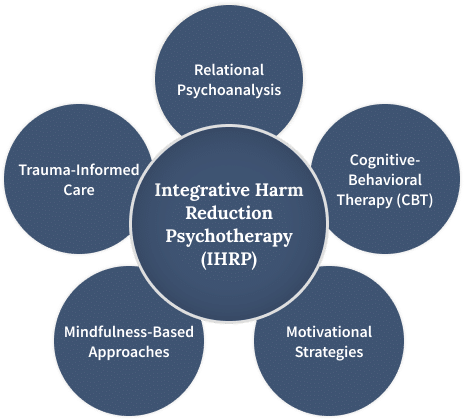
Integrative Harm Reduction Psychotherapy (IHRP)
The foundation of all my work. A comprehensive approach that respects autonomy, meets people where they are, and supports any positive change goal.
Relational Psychoanalysis
Understanding how early relationships and attachment patterns influence your current relationship with substances and with yourself.
Cognitive-Behavioral Therapy (CBT)
Practical skills for identifying triggers, changing thought patterns, and developing new behaviors that support your goals.
Motivational Strategies
Working with ambivalence rather than against it. Exploring the pros and cons of change. Building internal motivation rather than relying on external pressure.
Mindfulness-Based Approaches
Developing present-moment awareness, emotional regulation skills, and the ability to respond rather than react to cravings or difficult emotions.
Trauma-Informed Care
Recognizing how trauma impacts substance use and ensuring therapy itself doesn’t retraumatize. Creating safety and rebuilding trust.
Is Harm Reduction Therapy Right for You?
Consider these questions:
- Do you feel conflicted about your relationship with alcohol or drugs?
- Have you tried traditional treatment (rehab, AA, etc.) and found it didn't fit?
- Do you resist being labeled as an "addict" or "alcoholic"?
- Are you looking for autonomy in defining your own recovery goals?
- Do you want to explore moderation or safer use rather than immediate abstinence?
- Have you experienced judgment or shame in previous treatment settings?
- Are you ready to make some changes but not sure what those changes should look like?
- Do you want a therapist who will meet you where you are?
If you answered yes to several of these questions, harm reduction therapy may be a good fit for you. The best way to know for sure is to schedule a 15-minute consultation.
Rate, Insurances, and Practical Details
Insurance and Payment:
- Insurance: I’m a private pay provider and don’t accept insurance directly.
- Out-of-Network Benefits: I provide detailed superbills that you can submit to your insurance company for out-of-network reimbursement. Many clients receive partial reimbursement. I’m happy to discuss this in your consultation.
- Payment: Payment is expected at time of service. I accept credit cards, checks, and electronic payments.
Cancellation Policy:
48-hour notice required for cancellations or rescheduling. Late cancellations or no-shows are charged the full session fee unless the appointment time can be filled.
Scope of Practice and Referrals
Clear scope of practice is essential to ethical and effective care. The following clinical presentations fall outside my treatment scope:
Out of Scope:
I do not provide primary treatment for severe psychotic disorders requiring hospitalization, active suicidal crises requiring emergency or inpatient intervention, primary therapy for children, or medical detoxification and withdrawal management. In cases where acute stabilization or medical oversight is required, referral to appropriate psychiatric or medical services is necessary.
Clinical Approach to Referral
When a client’s needs exceed the level of care I provide, I prioritize coordinated referral to appropriate providers or higher levels of care. This may include collaboration with psychiatrists, inpatient programs, intensive outpatient programs, or medical detox services. Maintaining client safety and continuity of care remains central in all referral decisions.
A Different Approach: Harm Reduction Therapy
In-Person Sessions
Office locations in New York City (East Village and Midtown areas). Offices provide privacy, comfort, and a professional therapeutic environment.
Telehealth Sessions
Secure, HIPAA-compliant video sessions available for clients located in New York State. Many clients find telehealth convenient and prefer it for ongoing therapy.
How to Get Started
The first step is to reach out via the contact form, email, or phone to schedule your free 15-minute consultation. From there, we’ll determine if we’re a good fit and schedule your first session if appropriate.
Typical Wait Time
1-4 weeks depending on current caseload. I maintain a limited practice to ensure I can give full attention to each client.
Ready to Start?
You’ve learned about the approach. You understand how it’s different. Now it’s time to take the next step.